
The company has recently been granted two more Chinese invention patents in the field of dilution refrigerators once again, continuing its independent and self-reliant development of a complete technology chain in this field.
Back
2026-04-13
Recently, once again, Shanghai Boreas Cryogenics Co., Ltd. has been granted two more Chinese invention patents in the field of dilution refrigerators, continuing its independent and self-reliant development of a complete technology chain in this field.
The widely used cryogen-free dilution refrigerator is a relatively complicated hybrid cryocooling system, mainly involving three sub-technologies which consist of three types of cryogenic sub-cycles: first, a pulse tube cycle that precools the initial stage; second, a throttling cycle that provides relay cooling in the middle stage (which, together with the precooling stage, constitutes a hybrid cycle in the usual context); and finally, a 3He/4He dilution refrigeration cycle that achieves millikelvin temperatures in the final mixing chamber.
Internationally, very few suppliers or research institutions possess the capability to simultaneously master all three of the aforementioned sub-technologies. Almost all require the external purchase of one or even two sub-cycle systems to complete the overall dilutionrefrigerator system.
Under the leadership of Professor Haizheng Dang, the founder and chief scientist of Shanghai Boreas Cryogenics Co., Ltd., the company has conducted long-term, dedicated research, relentless exploration, and arduous accumulation in all three sub-technologies. Currently, the company has obtained a series of independent intellectual property rights in all three areas, thus becoming one of the very few manufacturers and service providers internationally to master all the core elements of cryogen-free dilution refrigerators.
The two Chinese invention patents authorized this time are as follows:
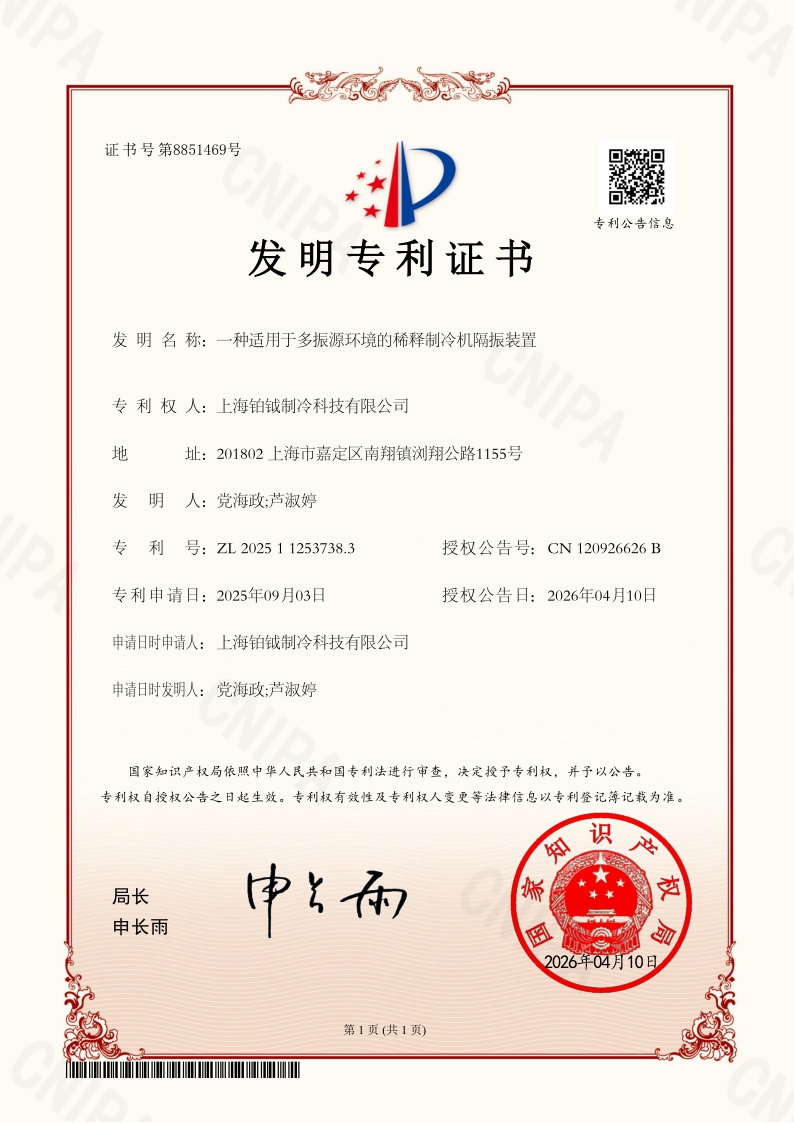
01) A vibration isolation device for a dilution refrigerator suitable for multi-vibration source environments
This invention discloses a vibration isolation device for a dilution refrigerator suitable for multi-vibration source environments. It includes a flexible vibration isolation structure, a mechanical refrigerator vibration isolation structure, an overall vibration isolation frame for a cryostat, and vibration isolation structures for external auxiliary equipment. The overall vibration isolation frame for the cryostat includes a cross-braced reinforced frame, with a cryostat support plate at the top. Air damping pads are provided between the four corners of the cryostat support plate and the top surface of the cross-braced reinforced frame. The flexible vibration isolation structure is positioned between the cold head of the mechanical refrigerator and the cold plate of the dilution refrigerator. This invention effectively isolates multi-source mechanical vibration interference, improves the operational stability and measurement accuracy of the cryostat in the dilution refrigerator, and ensures the stable and effective operation of important applications requiring extremely low external interference, such as quantum computing and ultra-low temperature physics experiments.
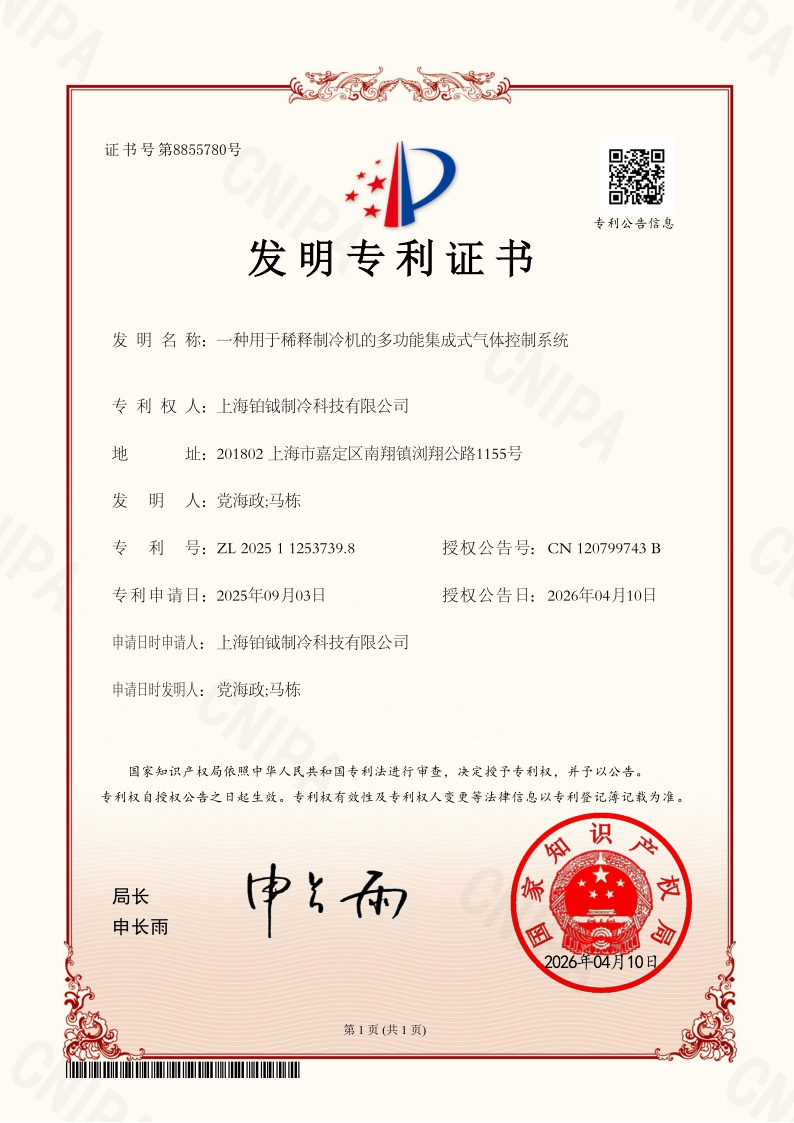
02) A multifunctional integrated gas control system for dilution refrigerations
This invention discloses a multifunctional integrated gas control system for a dilution refrigerator, which consists of a liquid nitrogen cold trap, a gas buffer tank, an integrated valve box, a dilution refrigeration internal circulation pipeline, a diaphragm compressor, a Roots pump, a turbomolecular pump, and a vacuum suction pump assembly. The system uses a highly integrated valve box module to control the gas path during different stages of the dilution refrigeration cycle, including start-up, operation, and shutdown/rewarming. This invention optimizes the flow conduction and reduces heat loss for gas paths at different temperature ranges and pressures, while ensuring high airtightness across the entire temperature range from room temperature to extremely low temperatures. This improves the reliability and automation of the dilution refrigerator and has significant implications for the practical application of dilution refrigerators.
Next